
Description
PrymaLab · Research Use Only
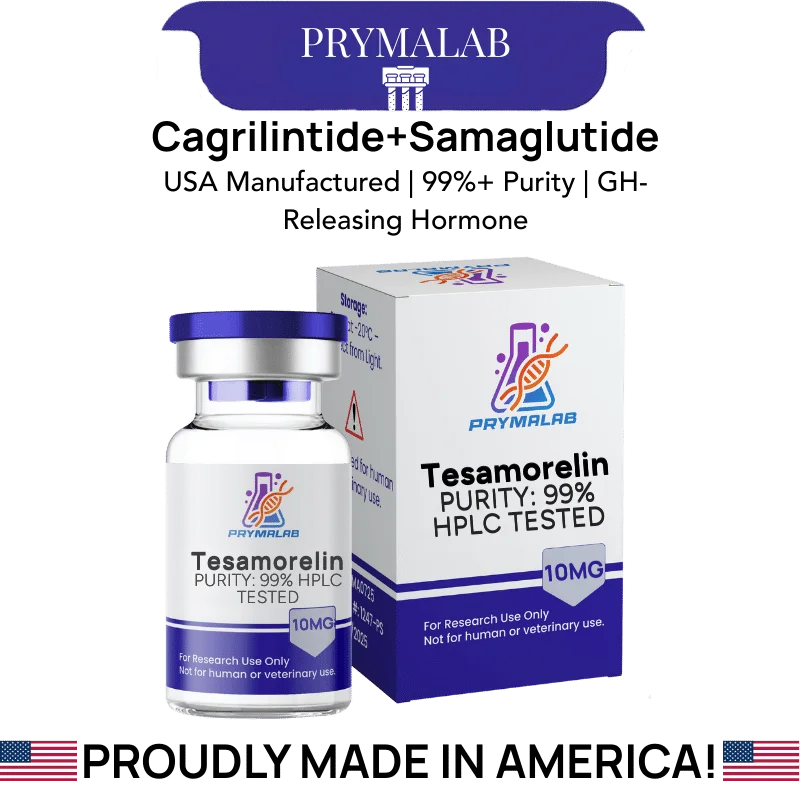
Cagrilintide 5mg + Semaglutide 5mg
Amylin analogue + GLP-1 analogue · two receptor systems · 10mg total
Cagrilintide semaglutide is a lyophilized vial pairing two long-acting acylated peptides, 5mg of each. Cagrilintide, CAS 1415456-99-3, is an amylin analogue that acts at both amylin and calcitonin receptors. Semaglutide, CAS 910463-68-2, is a 31-residue glucagon-like peptide-1 analogue. It acts at the GLP-1 receptor.
Specification Table
| Property | Value |
|---|---|
| Total peptide content | 10 mg |
| Component 1 | Cagrilintide, 5 mg |
| Component 2 | Semaglutide, 5 mg |
| CAS, cagrilintide | 1415456-99-3 |
| CAS, semaglutide | 910463-68-2 |
| Molecular formula, cagrilintide | C194H312N54O59S2 |
| Molecular formula, semaglutide | C187H291N45O59 |
| Molecular weight, cagrilintide | 4409.01 g/mol |
| Molecular weight, semaglutide | 4113.64 g/mol |
| Residue count, semaglutide | 31 |
| Compound class, cagrilintide | Long-acting acylated amylin analogue |
| Compound class, semaglutide | Long-acting acylated GLP-1 analogue |
| Receptors, cagrilintide | Amylin receptors (AMY1-3) and the calcitonin receptor (CTR) |
| Receptor, semaglutide | Glucagon-like peptide-1 receptor (GLP-1R), a class B GPCR |
| Acylation strategy, both | Fatty-acid side chain promoting albumin binding and extending half-life |
| Molar content, cagrilintide | Approximately 1.13 µmol |
| Molar content, semaglutide | Approximately 1.22 µmol |
| Molar ratio in vial | Approximately 1 : 1.07 (cagrilintide : semaglutide) |
| Appearance | White lyophilized cake |
| Purity | Per lot-specific certificate of analysis |
| Solubility | Soluble in bacteriostatic and sterile water |
| Storage, lyophilized | 2-8°C or -20°C, protected from light |
| Storage, reconstituted | 2-8°C, protected from light. Do not freeze reconstituted solution |
| Regulatory status | Neither component is approved in this combination for research supply. Not for human or veterinary use |
How Does Cagrilintide Work?
Cagrilintide is an engineered analogue of amylin, a 37-residue peptide co-secreted with insulin from pancreatic beta cells. Native amylin is prone to aggregation into amyloid fibrils, which is one reason a stabilised analogue was needed before the pharmacology could be studied properly at length.
It acts at the amylin receptor family, which is itself an unusual arrangement worth understanding. Amylin receptors are not standalone proteins. They are heterodimers formed when the calcitonin receptor associates with one of three receptor activity-modifying proteins, RAMP1, RAMP2 or RAMP3, producing the AMY1, AMY2 and AMY3 subtypes respectively. The RAMP partner changes the ligand selectivity of the same underlying receptor.
Cagrilintide is described in the literature as non-selective across these subtypes and also active at the calcitonin receptor itself. That breadth distinguishes it from a subtype-selective tool compound and is relevant to interpreting any observed effect.
The acylation is the second engineering feature. A fatty-acid side chain promotes reversible binding to serum albumin, which shields the peptide from renal clearance and extends its half-life into the range that supports once-weekly exposure in the published trials.
Does Cagrilintide Slow Gastric Emptying?
Slowing of gastric emptying is one of the best-characterised physiological actions of amylin signalling, and it appears in the published characterisation of amylin analogues generally.
The mechanism is understood to be centrally mediated rather than a direct effect on stomach muscle. Amylin receptors in the area postrema, a circumventricular organ where the blood-brain barrier is incomplete, provide a route for circulating peptide to influence brainstem circuits that regulate gastric motility and food intake.
That has a specific methodological consequence worth knowing. Slowed gastric emptying alters the absorption profile of anything else administered orally in the same model, which can confound pharmacokinetic measurement of a co-administered compound. A study measuring oral absorption alongside an amylin analogue is measuring two things at once.
For work with this vial, the relevant point is that both components influence gastric emptying through separate receptor systems. Attributing an observed change to one of them requires single-component arms.
What Do the Published Trials Cover?
The clinical literature on this pairing is real and reasonably recent, which distinguishes it from most combinations in this catalogue.
Enebo and colleagues published a randomised, placebo-controlled, multiple-ascending phase 1b trial examining safety, tolerability, pharmacokinetics and pharmacodynamics of cagrilintide co-administered with semaglutide 2.4 mg (Enebo et al., The Lancet, 2021;397(10286):1736-1748). Participants were aged 18 to 55 with a body-mass index between 27.0 and 39.9, recruited at a single United States centre.
Lau and colleagues reported a separate phase 2 evaluation of cagrilintide as a single agent in the same journal that year (Lau et al., The Lancet, 2021;398(10317):2160-2172).
Semaglutide itself has a much deeper record. Lau and colleagues described its design and discovery, including the acylation strategy underpinning its half-life (Lau J et al., Journal of Medicinal Chemistry, 2015;58(18):7370-7380).
What none of this literature covers is the specific 5mg-plus-5mg fixed pairing supplied here. The published co-exposure work used separately titrated amounts of each component, not a fixed-ratio blend, and the two are not equivalent experimental conditions.
Why the Fixed Ratio Changes the Experiment
The vial holds 5mg of each component, which is close to equimolar by coincidence rather than design. Cagrilintide, at a molecular weight of 4409.01, gives approximately 1.13 micromoles. Semaglutide at 4113.64 gives approximately 1.22. The ratio is roughly 1 to 1.07.
That near-parity is convenient and it is not what the clinical work used. In the published co-exposure studies each component was titrated on its own schedule, because they have different tolerability profiles and different exposure-response relationships. A fixed ratio removes that flexibility entirely.
The consequence for research design is that this vial answers a narrower question than the trials did. It can address what happens at one specific ratio. It cannot address ratio-dependence, and any finding from it should be reported with the ratio stated rather than described as a property of the combination in general.
Anyone modelling the published trial conditions needs separate single-component vials, not this blend.
How Should Cagrilintide Semaglutide Be Reconstituted?
Cagrilintide semaglutide is supplied at ten milligrams total, roughly 2.35 micromoles combined. Reconstitution volume sets both component concentrations at once. That is the defining constraint of any fixed blend.
Bacteriostatic water is the usual choice for a preparation drawn multiple times, sterile water for single use. Add diluent slowly against the vial wall and swirl gently until the cake clears. Do not shake. Acylated peptides of this size are surface-active, and agitation produces foaming that indicates protein at the air-liquid interface, where denaturation happens.
Two millilitres gives approximately 2.5 mg/ml of each component. One millilitre gives 5 mg/ml of each. Neither is more correct than the other, and the choice should be recorded because both component concentrations depend on it.
Adsorptive loss is worth attention. Acylated peptides bind readily to plastic and glass surfaces, and the fatty-acid side chain that extends half-life in circulation is precisely what makes them stick to a pipette tip. Low-binding consumables reduce the loss.
Why Do Two Anorexigenic Pathways Get Combined?
Pairing cagrilintide semaglutide has a mechanistic logic worth setting out, along with what that logic does not establish.
Amylin and GLP-1 are both released after nutrient intake, and both act on central circuits governing food intake. They engage different receptors on different neuronal populations to do it. Amylin signalling runs substantially through the area postrema, where the incomplete blood-brain barrier gives circulating peptide direct access. GLP-1 receptors are spread considerably more widely, taking in the nucleus tractus solitarius and several hypothalamic nuclei.
Two separate entry points into one overlapping circuit is the mechanistic argument for putting them together. Engaging both is not the same experimental condition as engaging either at twice the exposure.
What the argument does not establish is the magnitude of any combined effect, or whether it exceeds the sum of the parts. That is an empirical question, and the published clinical work co-administering these two compounds was designed to begin answering it rather than assuming it.
For research using this vial, the mechanistic framing is useful mainly as a reason to include single-component arms. Without them, an observed effect cannot be attributed to either pathway or to their interaction, and the fixed ratio means the design cannot vary the balance between them either.
Does Cagrilintide Need to Be Refrigerated?
Yes for reconstituted cagrilintide semaglutide, and the answer for lyophilized material is more forgiving but still cold.
Lyophilized peptide of this class is normally held at 2-8°C for medium-term storage or -20°C for longer, protected from light in both cases. The dry state suppresses most degradation, so ambient excursions during shipping are generally tolerated better than they would be for a solution.
Reconstituted solution is different. Hold it at 2-8°C and protect it from light. Importantly, do not freeze reconstituted solution of acylated peptides of this type. Freeze-thaw promotes aggregation, and for peptides carrying fatty-acid side chains the aggregation risk is higher than for unmodified sequences because the hydrophobic chain drives association.
That makes aliquoting less useful here than for most peptides, since the usual purpose of aliquoting is to permit freezing. Instead, reconstitute the volume the work will actually consume within the refrigerated shelf life the laboratory has established, and record that interval.
Published Literature
Every reference below was checked against a publisher record or primary index. Note what is missing from the list. Not one of them examines the fixed 5mg-plus-5mg pairing supplied here.
- Enebo LB, Berthelsen KK, Kankam M, Lund MT, Rubino DM, Satylganova A, Lau DCW. The Lancet. 2021;397(10286):1736-1748. PMID: 33894838
- Lau DCW, Erichsen L, Francisco AM, Satylganova A, le Roux CW, McGowan B, Pedersen SD, Pietiläinen KH, Rubino D, Batterham RL. The Lancet. 2021;398(10317):2160-2172.
- Lau J, Bloch P, Schäffer L, Pettersson I, Spetzler J, Kofoed J, Madsen K, Knudsen LB, McGuire J, Steensgaard DB, Strauss HM, Gram DX, Knudsen SM, Nielsen FS, Thygesen P, Reedtz-Runge S, Kruse T. Journal of Medicinal Chemistry. 2015;58(18):7370-7380.
- Hay DL, Chen S, Lutz TA, Parkes DG, Roth JD. Pharmacological Reviews. 2015;67(3):564-600.
- Knudsen LB, Lau J. Frontiers in Endocrinology. 2019;10:155.
Frequently Asked Questions
What is in this cagrilintide semaglutide vial?
Cagrilintide at 5mg and semaglutide at 5mg, together in one lyophilized vial giving 10mg total. Cagrilintide is an acylated amylin analogue acting at amylin and calcitonin receptors, and semaglutide is a 31-residue GLP-1 analogue acting at the GLP-1 receptor. Laboratory research use only.
How does cagrilintide work?
It is an engineered analogue of amylin acting at the amylin receptor family, which is itself an unusual arrangement. Those receptors are heterodimers, formed when the calcitonin receptor associates with RAMP1, RAMP2 or RAMP3 to give the AMY1 through AMY3 subtypes. Cagrilintide is non-selective across them.
Does cagrilintide slow gastric emptying?
Slowed gastric emptying is a well-characterised action of amylin signalling, understood to be centrally mediated rather than a direct effect on stomach muscle. Amylin receptors sit in the area postrema, where an incomplete blood-brain barrier gives circulating peptide access to brainstem circuits governing motility.
Does cagrilintide need to be refrigerated?
Yes. Lyophilized material goes to 2 to 8 Celsius for medium-term storage or minus 20 for longer, protected from light throughout. Reconstituted solution must be held at 2 to 8 and should never be frozen, since freezing and thawing promote aggregation in peptides carrying fatty-acid side chains.
How should the vial be reconstituted?
Add diluent slowly down the vial wall and swirl until the cake clears, without shaking. Acylated peptides are surface-active, and foaming signals protein gathering at the air-liquid interface where denaturation happens. Two millilitres gives roughly 2.5 mg/ml of each component.
What does the acylation do?
A fatty-acid side chain promotes reversible binding to serum albumin, shielding the peptide from renal clearance and stretching its half-life into the range that supports once-weekly exposure in the published trials. That same side chain is why these peptides stick to plastic and glass.
What is the molar ratio in the vial?
Approximately 1 to 1.07, marginally favouring semaglutide. Cagrilintide at 4409.01 gives roughly 1.13 micromoles per 5mg. Semaglutide at 4113.64 gives roughly 1.22. The near-parity is a coincidence of similar molecular weights rather than a designed feature.
Do the published trials use this ratio?
No, and this is the most important limitation of the format. The co-exposure work titrated each component on its own schedule, because they have different tolerability profiles and different exposure-response relationships. A fixed-ratio blend simply cannot reproduce that design.
What clinical literature exists?
A randomised placebo-controlled phase 1b trial of cagrilintide given alongside semaglutide 2.4 mg, published in The Lancet in 2021, plus a separate phase 2 evaluation of cagrilintide alone in the same journal that year. Semaglutide has a much deeper record including its 2015 discovery paper.
Why does gastric emptying matter methodologically?
Because slowed emptying alters the absorption profile of anything else given orally in the same model, which confounds pharmacokinetic measurement of a co-administered compound. Both components here influence emptying through separate receptor systems. Attribution therefore requires single-component arms.
Why combine two pathways acting on the same circuit?
Because the two enter that circuit at different points rather than simply duplicating one another. Amylin signalling runs largely through the area postrema, where an incomplete blood-brain barrier grants circulating peptide direct access to the brainstem. GLP-1 receptors are spread more widely, taking in the nucleus tractus solitarius and hypothalamic nuclei as well.
Does the mechanistic logic establish a combined effect?
No. It establishes only that engaging both is a different experimental condition from engaging either at twice the amount. Magnitude, and whether any combined effect exceeds the sum of its parts, remains an empirical question that the published work was designed to begin answering.
What does this mean for study design?
Include single-component arms, without exception. An observed effect otherwise cannot be attributed to either pathway or to their interaction. The fixed ratio also stops the design varying the balance between components, and that limitation belongs in any write-up.
Compliance Statement
This cagrilintide and semaglutide vial is sold exclusively for laboratory research use. It is not a drug, food, or cosmetic product, and it is not a dietary product of any kind. It is not approved by the FDA or any comparable authority for human or veterinary use, and no approved product exists in this fixed-ratio combination. This product is not intended to diagnose, treat, cure, or prevent any disease. It must not be given to humans or animals. Purchase is restricted to qualified researchers and institutions operating within applicable laws. All handling is the responsibility of the purchasing laboratory.
Other formats of Cagrilintide + Semaglutide
Cagrilintide + Semaglutide is also stocked as Cagrilintide 10mg, Cagrilintide 20mg preloaded 3ml pen, cagrilintide 2.5mg + semaglutide 2.5mg, Semaglutide 5mg, Semaglutide 10mg, Semaglutide 15mg and Semaglutide 20mg. Each listing states its own quantity and concentration, and the pen and vial comparison explains what changes between formats.










19 reviews for Cagrilintide 5mg + Semaglutide 5mg